
Garage Door Spring Replacement in Providence, RI
A snapped garage door spring brings your day to an abrupt halt, trapping vehicles inside and rendering heavy overhead doors dangerous dead weight. PRO Garage Door Services provides fast, same-day broken garage door spring replacement across Providence, Cranston, Warwick, Pawtucket, and all of Providence County. We install premium 20,000+ high-cycle oil-tempered torsion springs calibrated to your door's exact weight.
Signs Your Spring Has Broken
Overhead door springs operate under tremendous mechanical tension. When a spring fails, it typically leaves unmistakable physical symptoms and operational warnings.
Visible Gap in the Coil
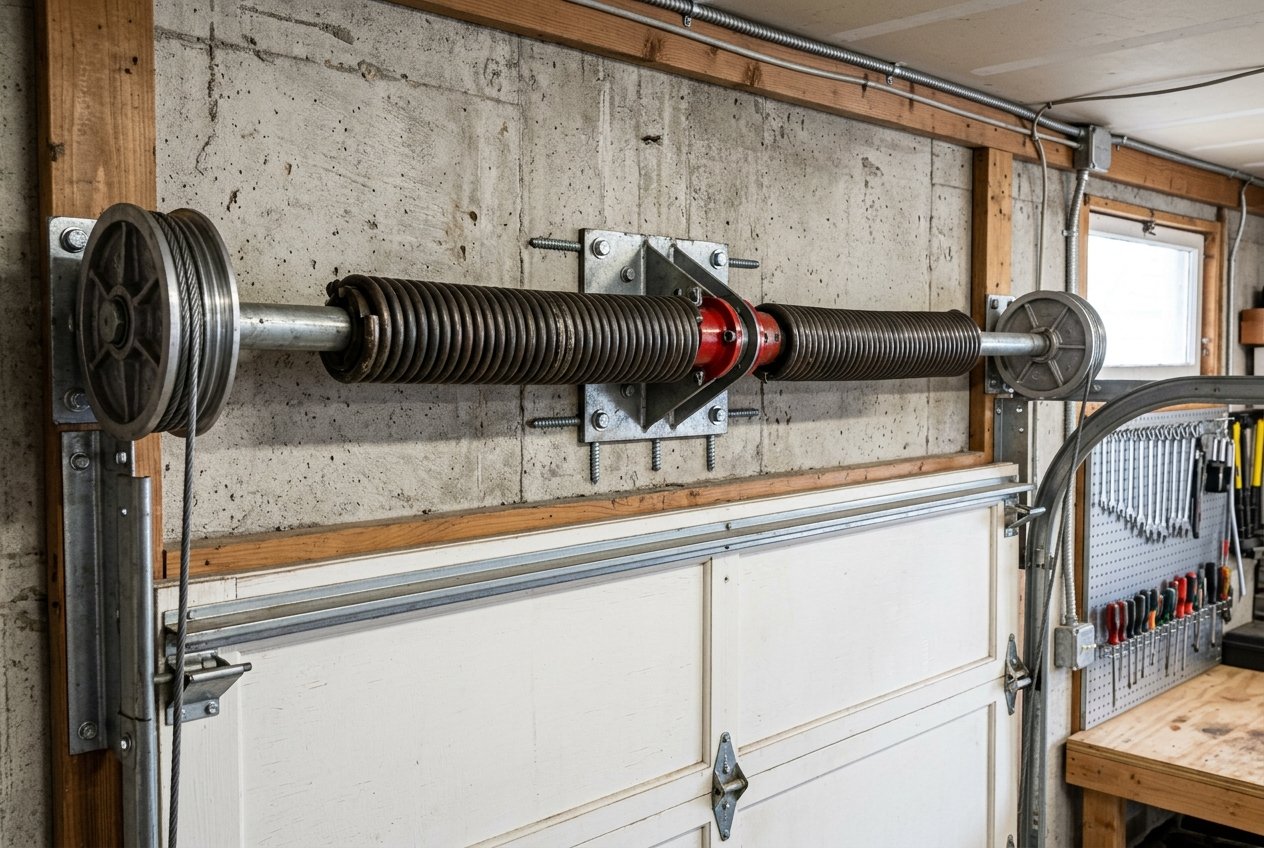
Torsion springs are mounted on the metal torsion shaft directly above the closed door. When a spring snaps, the tightly wound coil recoils, leaving a distinct 2- to 3-inch visible gap in the middle of the spring cylinder.
Door Won't Lift or Rises Only a Few Inches
Your garage door opener motor is designed to guide the door, not carry its full dead weight. With a broken spring, the opener struggles. It lifts the door a few inches and shuts off to protect its motor gears.
Loud Gunshot-Like Bang in the Garage
Garage door springs store massive torque. When the steel shears, it releases energy instantly with a loud bang that resembles a gunshot.
Door Slams Shut Rapidly
Without spring counterbalance, an open door can free-fall violently. This risks severe panel damage, shattered concrete, or personal injury.
Opener Motor Humming & Straining
When you press the remote or wall button, you hear the electric motor humming and straining against immovable resistance. Continuing to activate the opener will strip the nylon drive gear and burn out the logic board.
Loose or Spooled Lifting Cables
The high-tensile steel lift cables are held taut by spring tension. When a spring breaks, the cable loses its anchoring force, unraveling from the aluminum cable drum and hanging loosely down the side track.
Torsion vs. Extension Springs: Which Does Your Door Use?
Residential overhead doors rely on either torsion or extension springs. Understanding the engineering differences helps you choose the safest, longest-lasting replacement system for your home.
Torsion Springs
Modern Industry StandardTorsion springs mount horizontally directly above the garage door opening on a solid steel torsion tube. As the door closes, heavy steel cables turn aluminum drums that twist the springs, storing rotational torque.
- Location: Centered horizontally above the door opening on a solid shaft.
- Force Type: Rotational torque twisting around a stationary axis.
- Safety Profile: Springs remain locked onto the steel tube if they snap, preventing flying metal.
- Balance & Travel: Smooth, balanced movement calibrated to within ounces of door weight.
- Lifespan Options: High-cycle designs provide 20,000 to 30,000 opening cycles.
Extension Springs
Legacy SystemExtension springs mount parallel to horizontal overhead tracks along the ceiling. When the door descends, these springs stretch along the track, pulling against pulleys to counterbalance the door's downward weight.
- Location: Suspended along horizontal ceiling tracks on both sides of the garage.
- Force Type: Linear tension stretching along the ceiling tracks.
- Safety Risk: Without safety containment cables, snapped extension coils can become hazardous projectiles.
- Balance & Travel: Uneven stretching often pulls the door crooked, straining opener motors.
- Lifespan Options: Typical builder-grade units average 10,000 cycles before failing.
Engineering Comparison: Torsion vs. Extension
Overhead door springs must match your door's exact weight, track radius, and height. The table below outlines how each system compares across key technical factors:
| Feature / Factor | Torsion Springs (Shaft Mounted) | Extension Springs (Track Mounted) |
|---|---|---|
| Mounting Location | Directly above header on steel torsion tube | Suspended above horizontal tracks over vehicles |
| Energy Storage | Rotational torque across high-tensile steel coils | Linear stretching along ceiling track lengths |
| Failure Containment | Spring stays trapped safely on the center shaft | Requires safety cables to prevent wild recoil |
| Door Balance & Smoothness | Equalized lifting force via synchronized drums | Prone to uneven pull, side-racking, and jerking |
| Wire Sizing Precision | Calculated to .001 inch wire gauge and inner diameter | Selected by door weight category and color codes |
| Modern Safety Recommendation | Recommended for all replacement installations | Convert to torsion during replacement |
Why Spring Replacement is Not a DIY Repair
Replacing garage door springs without proper tools causes severe injuries. Winding and unloading spring torque requires professional training and equipment.
Massive Stored Kinetic Energy
A residential torsion spring is wound to approximately 30 to 34 quarter-turns under extreme mechanical torque. Releasing that energy without hardened winding bars can shatter bones or cause life-altering facial trauma.
Improvised Tools Cause Catastrophe
Homeowners who attempt winding springs with screwdrivers, rebar, or punches risk tools slipping out of the winding cone under load. Professional technicians use solid, tempered steel winding bars specifically fitted to the cone orifices.
Strict Wire Sizing & Torque Math
Spring sizing requires exact math. An error of 0.010 inches in wire diameter prevents the door from balancing or lifting properly.
Bottom Bracket Cable Danger
The bottom roller brackets hold the lifting cables and remain under full spring tension at all times. Unbolting bottom brackets without properly unloading spring torque has caused fatal projectile injuries.
Don't put your safety at risk. Let licensed Rhode Island professionals handle the tension safely.
Call For Safe Professional Replacement: (401) 289-8198Same-Day Replacement: What the Service Visit Involves
When our certified Providence technician arrives at your home, we perform a thorough, methodical replacement engineered for long-term safety and whisper-quiet door operation.
Weight Calculation & Hardware Diagnosis
We measure your door’s exact dimensions, material weight, track radius, and cable drum specifications. Our technicians calculate the precise wire gauge (.218, .225, .250, etc.) and spring length needed to provide neutral counterbalance.
Controlled De-Tensioning & Teardown
Using solid tempered steel winding bars, we safely unwind any residual torque from the unbroken companion spring. We disconnect the cable drums, remove the center bearing support bracket, slide off the snapped coils, and inspect the shaft for warping.
Installing Matched High-Cycle Springs
We install a brand-new, matched pair of oil-tempered steel torsion springs rated for 20,000+ cycles. We mount heavy-duty stationary cones to a reinforced center bearing plate and align high-tensile aircraft lift cables into the drum grooves.
Precision Torque Winding & Neutral Balance Test
We wind each spring to exact quarter-turn specifications. We disconnect the opener to test balance: a balanced door stays suspended at mid-travel without falling.
25-Point Safety Tune-Up & Opener Calibration
Every spring replacement includes our complete 25-point safety inspection. We lubricate all hinges, roller bearings, and spring coils with non-silicone industrial lubricant, tighten track bolts, test photo-eye reversal sensors, and calibrate opener travel limits.
Spring Lifespan and Cycle Ratings Explained
Overhead door springs do not age by the calendar. They age by usage cycles. One cycle equals one complete opening and closing sequence.
The Rhode Island Winter Impact on Garage Springs
In Providence County, winter temperatures routinely drop below freezing. Sub-zero temperatures cause steel to contract and become brittle. Most garage door springs snap between December and March when cold steel faces morning torque.
Our oil-tempered, corrosion-resistant torsion springs maintain elasticity in freezing conditions. We also apply rust-inhibiting coatings for coastal homes in Warwick and North Kingstown exposed to humid Narragansett Bay salt air.
Rhode Island Garage Door Spring Replacement Pricing Guide
We believe in upfront, transparent pricing without hidden surprises. Below is our complete Rhode Island service pricing guide for parts, labor, and calibration.
Included in Every Service Visit:
- • Safe mechanical de-tensioning and old hardware disposal
- • Matched oil-tempered spring installation
- • Complete 25-point overhead door safety inspection
- • Manual neutral balance test and calibration
- • Lubrication of hinges, rollers, and bearing plates
- • Electric opener force and travel limit adjustment
Local Rhode Island Service Coverage:
We dispatch mobile units daily across Providence, Cranston, Warwick, Pawtucket, and North Kingstown. Every truck carries over 30 wire sizes for immediate same-day completion with zero extra travel fees.
Fast Same-Day Broken Spring Replacement
Our service vans carry over 30 wire gauges and matched dual spring sets on every truck. We replace your broken spring on the very first visit with zero waiting for parts.
Frequently Asked Questions About Garage Door Springs
Everything you need to know about spring replacement, costs, safety, and cycle longevity in Providence, RI.